Montres Sans Spreadsheets From Citizen
We don't need no stinkin' market index.

Most of the watches that I write about cost thousands of dollars – tens of thousands, usually, but there are also a few in there kicking around in the six figure space; these are what you might call luxury watches, although sharp folks reading watch writing nowadays like to point out, and they are not wrong, that pretty much any watch is a luxury watch if you define a luxury as something other than a necessity. I like watches very much but it is hard to deny that if every watch I owned vanished tomorrow (possibly as the result of an intervention by a Bodhisattva who has noticed that my meditation practice notwithstanding I still form attachments to material objects like there’s no tomorrow) my life would hardly change at all. I would hope that other people’s watches would not be swept up in this horological rapture as I would be out of a job, but without a doubt, my own modest collection of watches definitely falls into the category of entertainment rather than necessity, which is always a salutary thing to think about once in a while.
It is possible, in fact, to end up taking the whole enterprise of watches and watchmaking very seriously and for various reasons. You might think that it’s a question of money and of course that can factor into it – spending thirteen million dollars on an FP Journe numbered Souscription Chronomètre à Résonance gives the transaction an air of seriousness which would be absent if it were just a few hundred bucks although as with any question of money, what constitutes serious has to do with how much you have. Still, thirteen million is a lot any way you slice it. There is of course, plenty of seriousness to be had at much lower price points and one can be very serious and earnest indeed about watches in particular and approaches to horology in general which do not involve objectively large sums of money, but connoisseurship takes on a different dimension when it doesn’t exist against the background of questions of value retention or investment value. Prices for fine watchmaking only ever seem to go up and they go up with, apparently, no relationship to any increase in the quality of the product. There may be reasons for price increases – tariffs, increased labor costs, asymmetries in currency exchange, the pressure of shareholders on publicly held companies to show increased margin every quarter – but those are rationalizations for raising prices, not incitements to desire.
So it’s interesting to look at a couple of watches which don’t have anything to do with the entire background and apparatus of artificial scarcity, luxury premium pricing, hype cycles, obsessing over market indexes, or auction records; that is to say, watches which can be appreciated as watches rather than as viral status symbols or financial instruments.
The two watches I’m looking at for this exercise are both made by Citizen, and they are both Eco-Drive watches.
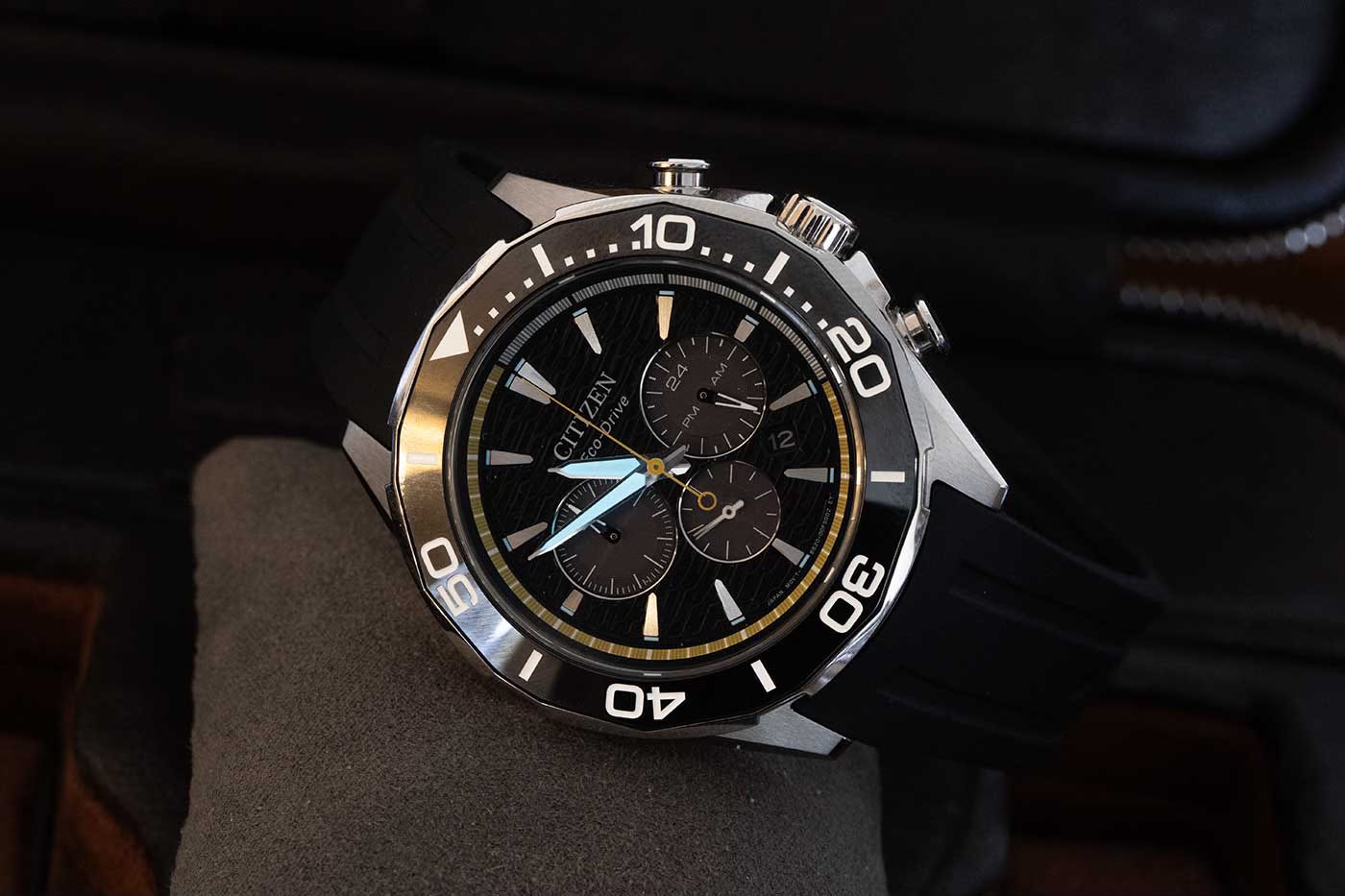
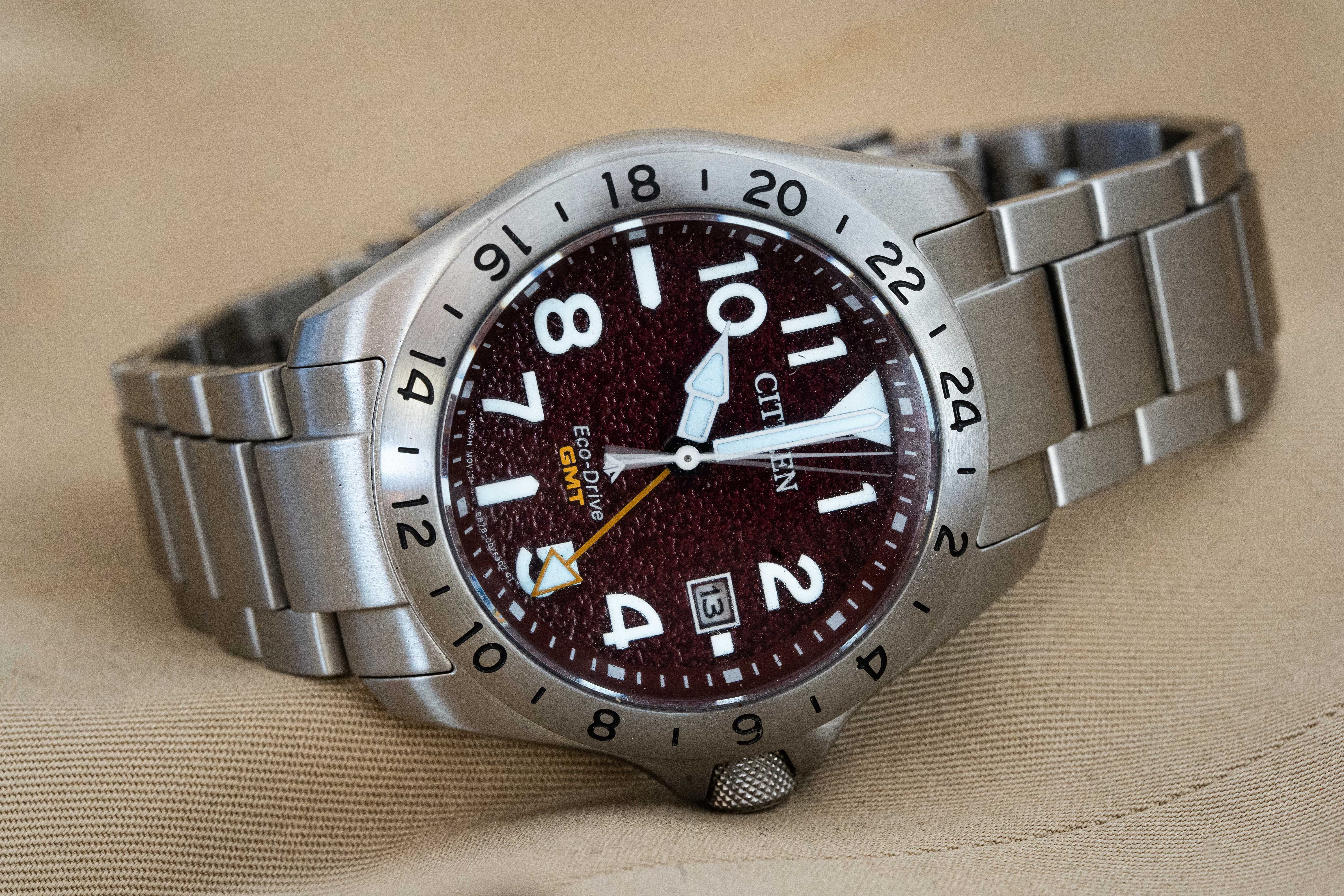
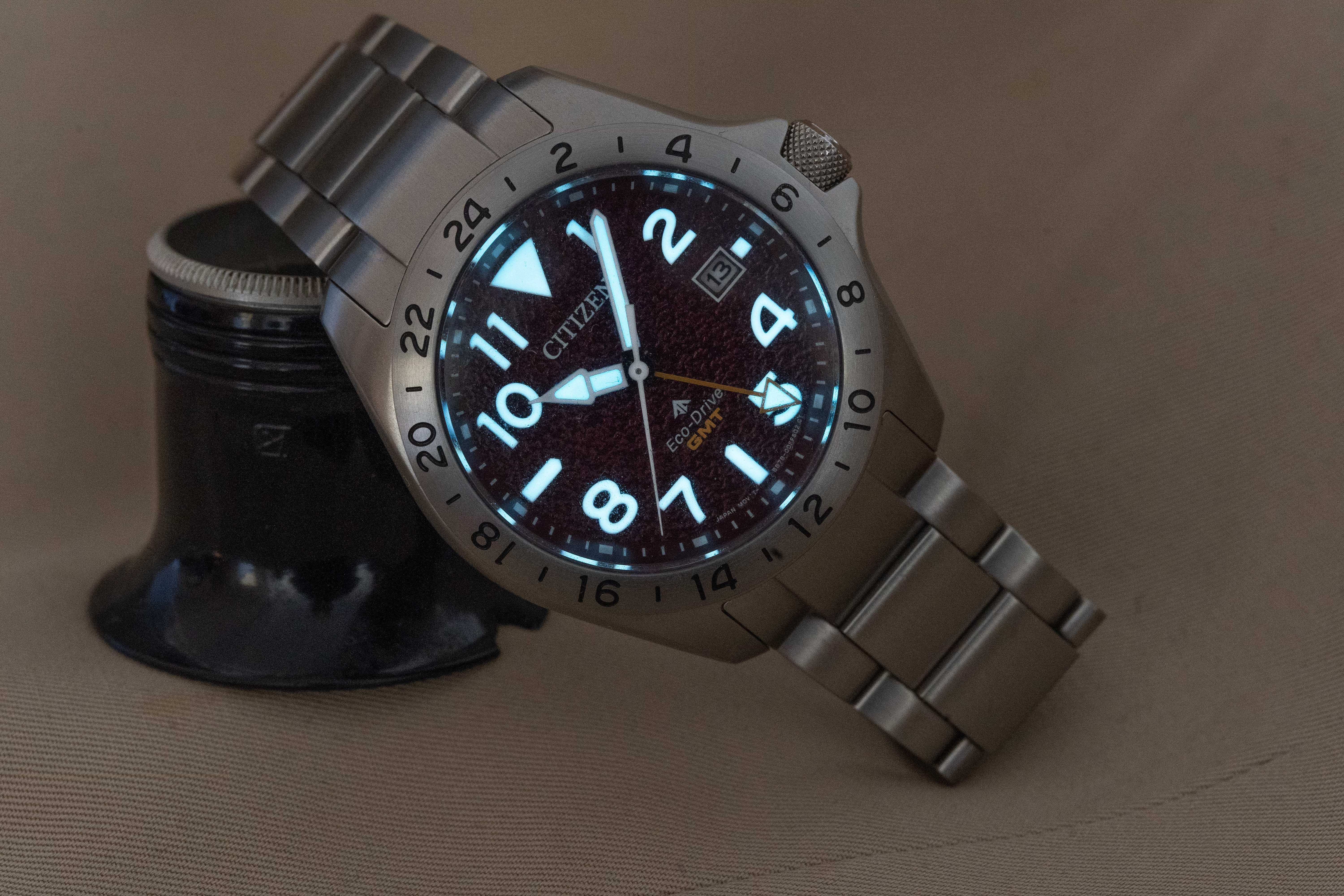
The two watches are the new Endeavor Chronograph and the Promaster Land GMT. The Promaster Land GMT is 200M water resistant, and it is a flyer GMT watch; the hour hand can be independently set for local time, while the 24 hour hand continues to show home time on a 24 hour format on the fixed bezel.
Eco-Drive watches are powered by light, and it doesn’t have to be sunlight; any light source will do, although direct sunlight is probably your best bet for a fast recharge. Eco-Drive watches have photoelectric cells usually hidden under the dial or concealed beneath the inner flange, or rehaut, and since the first light powered Citizen watches were introduced in the 1970s the technology has become more and more sophisticated, with modern Eco-Drive watches often featuring six month to one year power reserves. Eco-Drive dials are not transparent, but they are translucent so that enough light energy can get to the solar cell to maintain a healthy power reserve.
The electricity produced by the photoelectric cell charges a rechargeable lithium ion battery, which will eventually need to be replaced since even a rechargeable cell will sooner or later wear out after a certain number of cycles of charging and discharging. However, my experience with the (pauses to count) nine Eco-Drive watches I own, one of which is a first generation Skyhawk from the year 2,000, when it was introduced as an Eco-Drive update to the very popular Navihawk pilot’s watch, is that you can get at least ten years out of them and often quite a bit longer. Servicing may be a separate issue because an Eco-Drive watch with mechanical parts may need attention before the battery wears out, but in general the mechanical loads are so low that this is seldom a practical issue (my 26 year old Skyhawk’s hands move just fine during mode changing and other operations). You might need to think about having the gaskets changed at some point as well, especially if you have one of Citizen’s Eco-Drive dive watches (I have one with a titanium case and bracelet which has been in, by my count, one ocean, one sea, one lake, and several hotel swimming pools) but other than that, every single one I’ve had, has run without human intervention, with admirable accuracy (the Skyhawk for some reason is accurate to within less than a minute a year, I have no idea how) for a boringly long time.
That expense is not a prerequisite to connoisseurship and that there is much technical and historical interest to be found in quartz watches can be seen in places like the Performance Watch substack, (which was kind enough to resurface a story I did on the Grand Seiko 9F quartz caliber many years ago, and devoted enough to rigor to point out a mistake in the story) and there are many active discussion threads on HAQ, or High Accuracy Quartz, watches even today. An early example of connoisseurship with respect to Eco-Drive can be found in an article by Les Zetlein, written in 2001. His website is an example of a pretty early enthusiast review site and by some miracle it’s still online, with a small but fascinating number of very granular reviews of both quartz and mechanical watches. Zetlein was curious enough about the spec for precision for the Skyhawk – ±10 seconds per year – that he wrote to Citizen asking if the movement was thermocompensated; Citizen replied that it was not and then said, somewhat enigmatically:
“Thank you very much for your interest in our products, and very sorry for the delay of the response. The movement used for Eco-Drive Skyhawk is Cal. C650, and this movement is not thermo-compensated. We use the different means to achieve accuracy for this type of model. Thermo-compensated circuit is used in "yearly variation" models. We are now requesting our factory further information on Cal. 650, although we don't know if it is confidential or we can release it for you. We thank you very much again for writing to us. We'd be grateful if you would enjoy your Skyhawk for years to come. Best regards,
S. Kumagai
CS Headquarters, Japan”
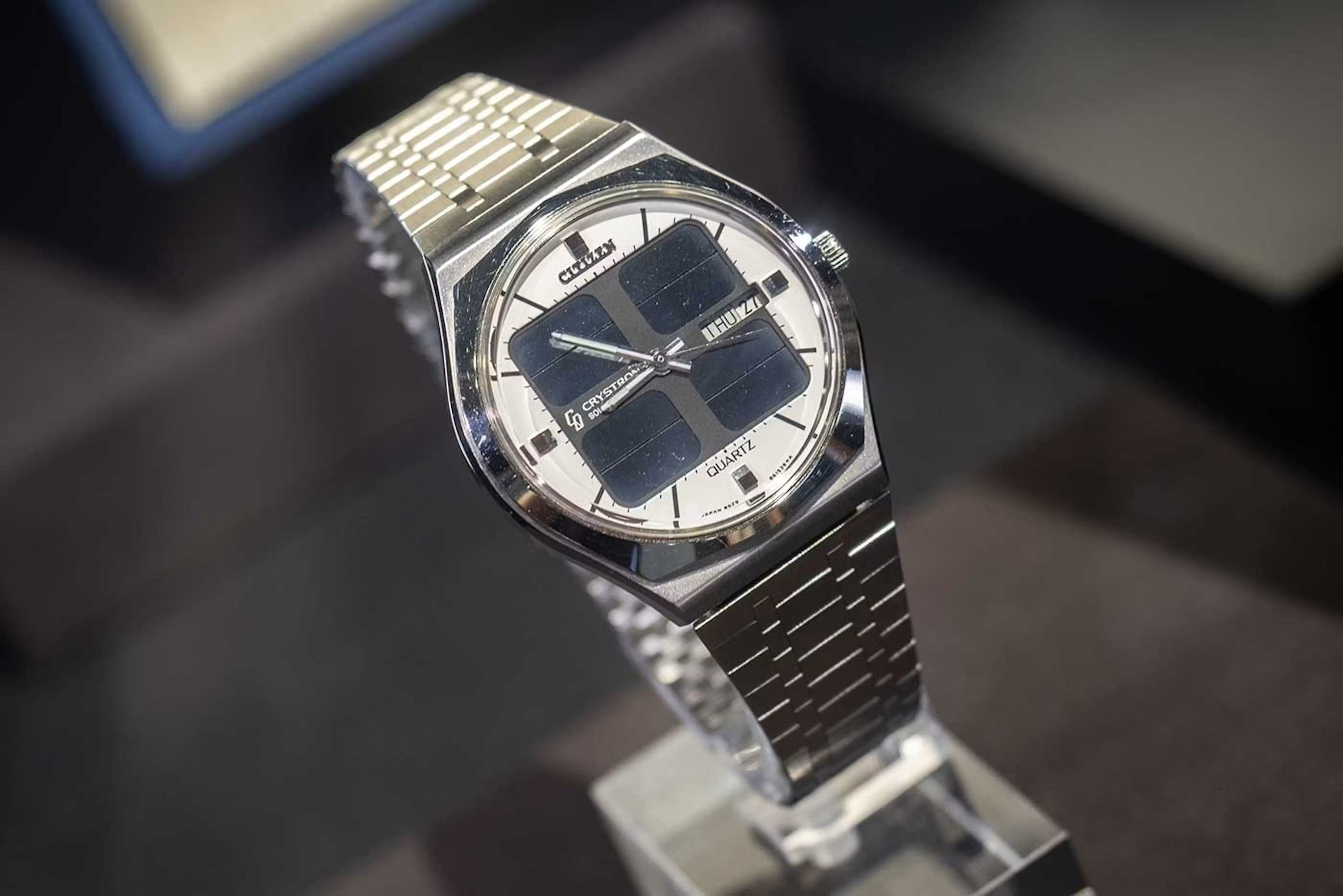
The two new-for-this-year models shown above are the beneficiaries of technical developments which have been going on at Citizen since the first Crystron solar cell watch came out in 1976.
The Promaster Land GMT is the latest in a long line of so-called Tough watches from Citizen, which have as their ancestors one of the burliest of burly tool watches ever made: the original Eco-Drive Super Tough, which is featured on another incredible enthusiast’s resource which has somehow survived for a quarter of a century: SteveG’s Watch Launchpad. This watch, which came out in 1999, was nicknamed the “Robert Swan” and SteveG says: .
“Citizen is of course the enormous Japanese watchmaking firm, and Eco-Drive is their spectacularly successful solar-powered quartz-controlled timekeeping technology. The descriptive Super Tough is applied to their watches providing special shock resistance, and Robert Swan is the English explorer famous as the first man to walk at both poles, organizer of the South Pole Challenge (1997), and creator of several related ecological organizations, at least one of which I imagine was partial beneficiary of proceeds from this eponymous watch.”
The original Super Tough looks like it means business:
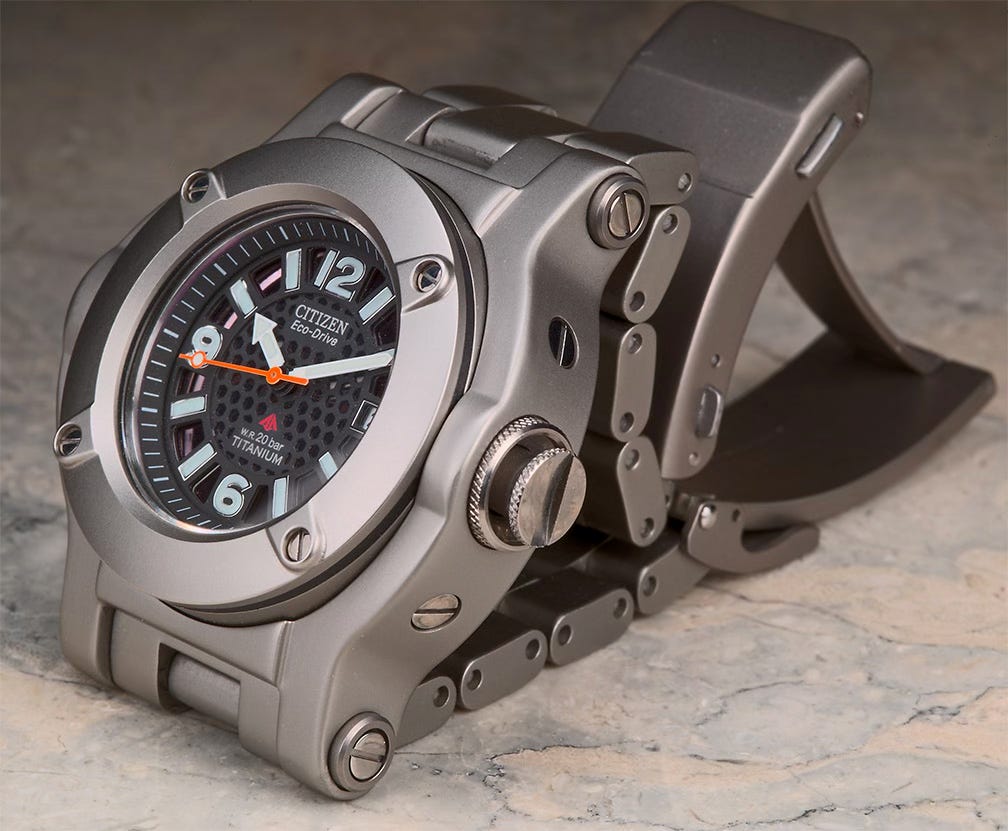
… and the Promaster Land GMT is its obvious descendant.
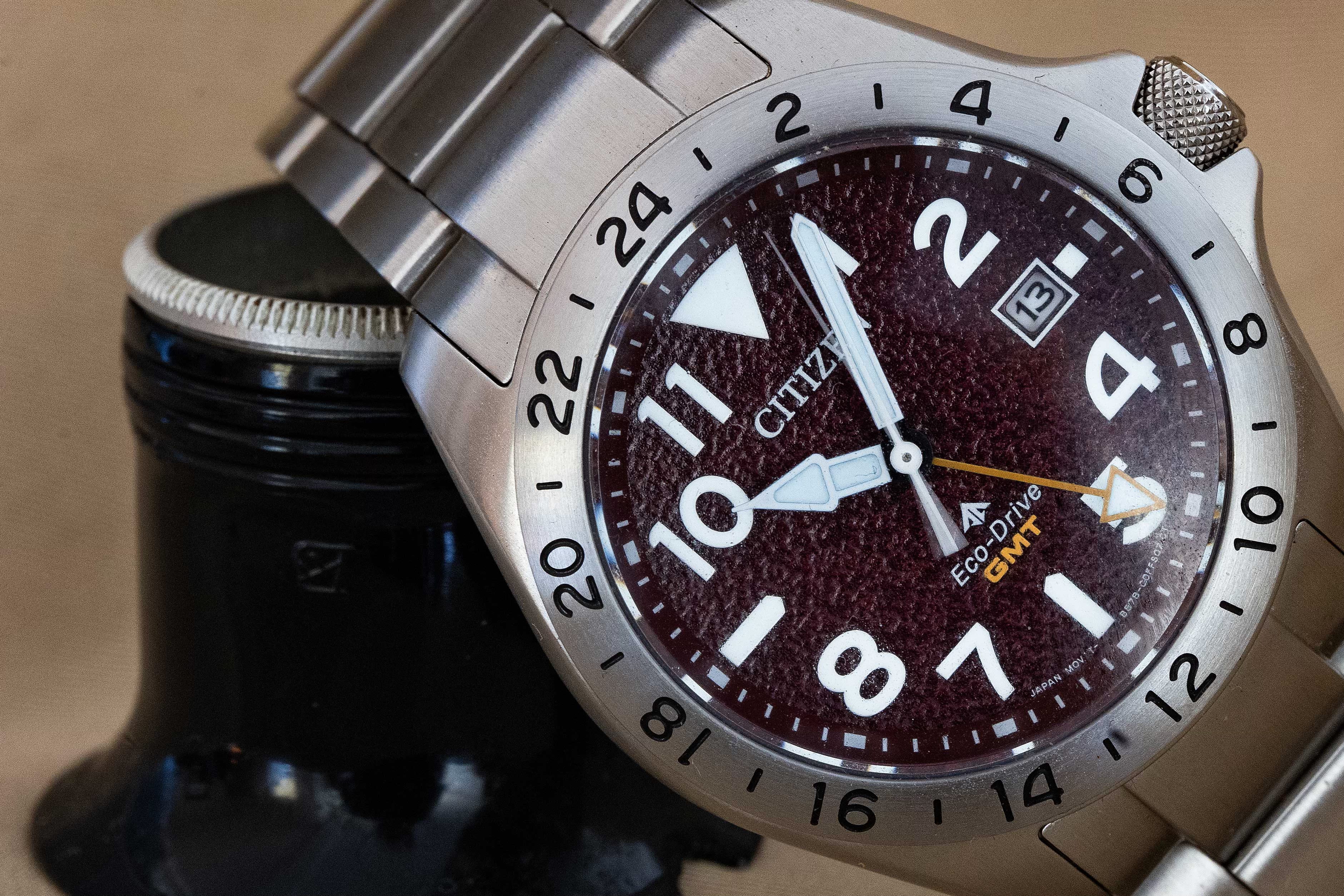
The watch has an interesting, sort of maroon-colored pebble-finished dial and as with the original Super Tough, legibility was obviously a priority in the design. The watch bears some similarity to the Rolex Explorer, although I think that’s pretty much just down to the fixed bezel with its engraved black 24 hour scale, and orange home time hand. There is one functional gotcha, which is that the hour hand can only be set forwards, not backwards, which means that if you’re flying west and need to set the hour hand back at your destination, you’ll have to go forward to the correct time and then correct the date, but other than that it’s about as functional and affordable a travel watch as you could want, and at 39.5mm, it’s easy to wear and practically begs to be rode hard and put away wet.
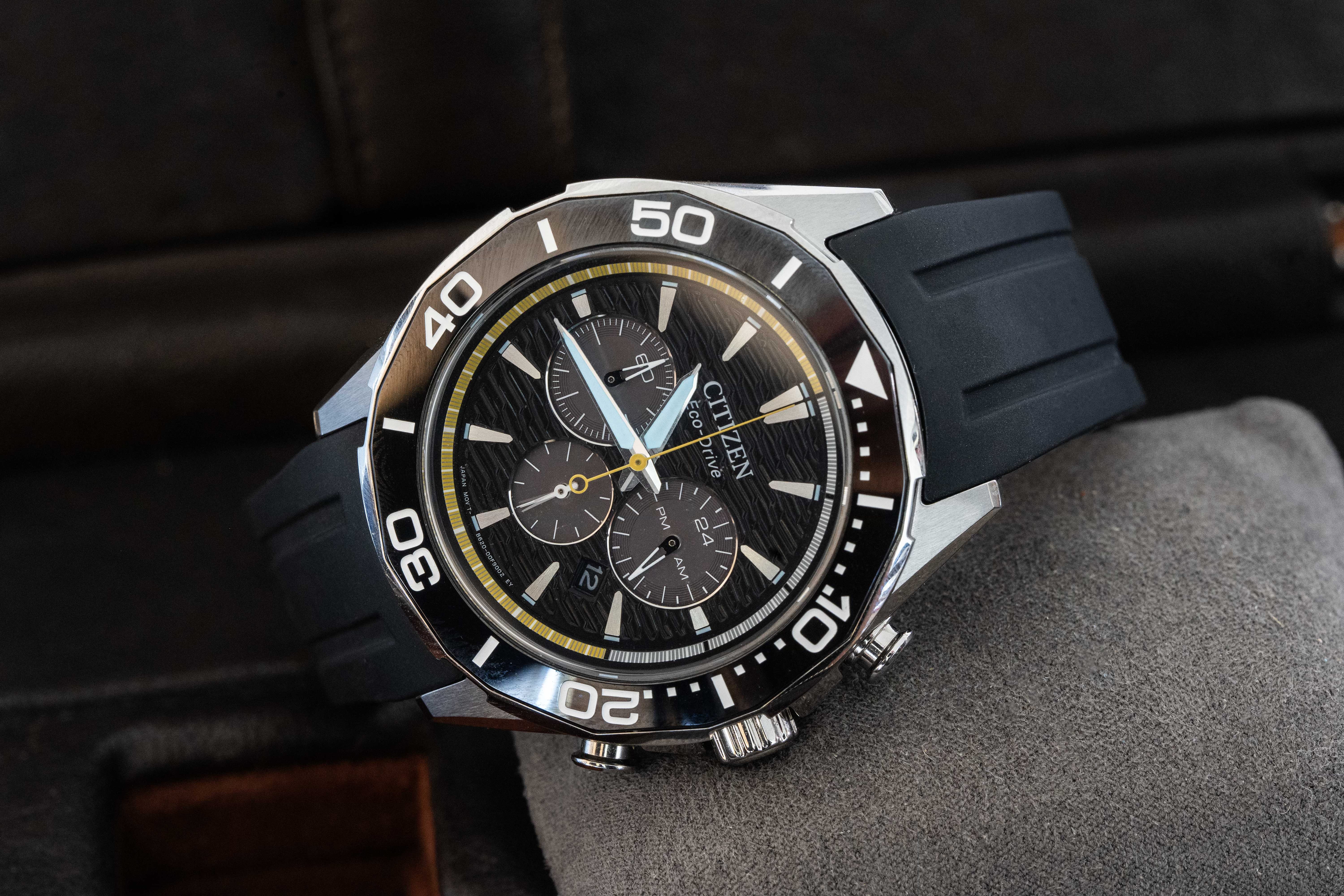
The Endeavor Chronograph is a bit larger, at 44mm and in stainless steel it’s a little heftier as well, but the rubber strap is fairly thick at the lugs and tapers quite a bit so overall, you don’t get much of a sense of bulk on the wrist; in fact, I had to double check that the case was steel and not titanium. The dial has an interesting wave-like pattern on it and there are a couple of interesting details. One is the rehaut, or dial flange, which carries the seconds track for the chronograph center seconds hand. The chronograph seconds hand jumps in 1/5 second increments (which corresponds to what you would see in a mechanical watch running at 18.000 vph/2.5Hz) and the seconds track is divided into very fine 1/5 second increments, with only slightly thicker one second markers. The first twenty second segment is in grey, and the rest of the rehaut is yellow – I’m not quite sure why functionally, but it matches the yellow of the very fine seconds hand. There is a 60 minute counter for the chronograph to the left, a small running seconds subdial at 6:00, and interestingly enough, a 24 hour hand on the right.
The bezel is a sixty click, unidirectional bezel and while this is not advertised as a diver’s watch it does fulfill all the requirements of the dive watch standard ISO 6425 – there is often a sentiment expressed that 100M is insufficient for recreational scuba but in fact, 100M is the specified minimum requirement in ISO 6425 and with the bright lume on the hands and the one way bezel, you should be good to go. Certainly I’d swim with this one on without worry. The 60 click bezel, by the way, has a ceramic insert, which of course will keep the watch looking crisp for the duration of its service life; the only thing I can wish for with respect to the bezel, is a lume pip on the triangle.
These are both very serviceable, well designed watches which while they obviously don’t draw from the history of fine mechanical watchmaking, nonetheless have a decades long history going back fifty years, and which represents considerable engineering skill. They can moreover, be appreciated on their own terms, and without any need to try to understand them in a context made more complicated by high prices, rapid-fire price increases without apparent improvements in the value proposition, and questions of value retention or investment value. They are also typical of Citizen in that they significantly overdeliver on quality for the price; the Endeavor Chronograph, a 2025 model year launch, is $476, and the Promaster Land GMT, a 2026 model year launch, is the same price: $476. (These prices are so reasonable relative to what I usually cover that it actually feels weird to type them out).
I don’t think there is any need in particular to compare them to anything being produced in the luxury watch segment in Switzerland, except of course to point out that Citizen also offers very high quality luxury level Eco-Drive, high precision watches with dials based on traditional Japanese crafts, in The Citizen Collection, which also includes mechanical pieces with movements made by Citizen’s subsidiary, La Joux Perret – and that therefore the company has an on ramp which may in the fullness of time lead to one of the higher end products, but which are perfectly capable of giving great satisfaction on their own.
Pretty much everyone I follow on Substack who writes about watches has written – often more than once – about how relentless price increases from the Swiss watch industry are part of a larger dysfunctional conversation in which artificial scarcity, performative demonstrations of access, and preoccupation with secondary market prices have become proxies for delivering value. With these watches, none of that noise is part of the experience and you have almost pure signal – of respect for consumers and respect for the value of a dollar, which is refreshing.
an honorable organization that give you what you pay for, what a rare thing today!
Montres sans spreadsheets, la vie sans souci
Thanks, Jack 🙏