Precision: Why The Worst Escapement In Watchmaking Is In One Of The Greatest Watches Of All Time
The verge is generally dismissed as a dog of an escapement, but John Harrison proved that handsome is as handsome does.

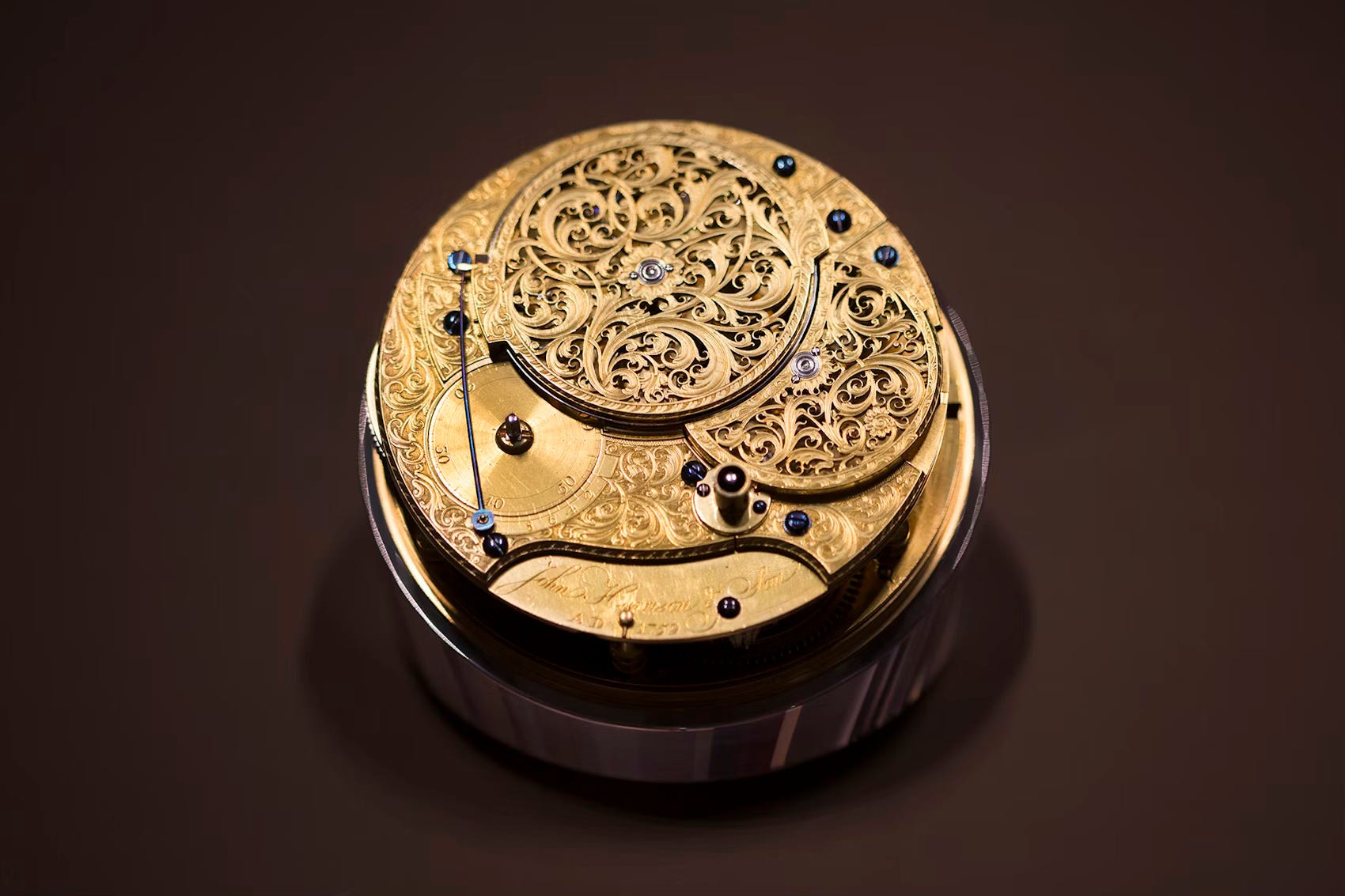
The earliest known type of purely mechanical escapement is the verge, and how it does what it does, and why it has been superseded, are questions key to understanding the pursuit of accuracy. The verge escapement has been obsolete for centuries, but over the course of its useful lifespan, it went from being barely capable of keeping time to the nearest hour, to being used in a watch which is arguably the first true portable precision timekeeper: John Harrison’s H4 marine chronometer.
It’s a fair question to ask why anyone would actually care about the verge escapement, and the issue of the lack of general interest is exacerbated by the fact that no one has taken the verge escapement seriously in the context of precision timekeeping for more than two hundred years. Even in the relatively small group of enthusiasts who take an interest in escapements for their own sake, the verge, of all the probably hundreds of escapement designs which have appeared since the 14th century (when the verge was the only game in town) is generally dismissed as an inherently bad, unimprovable mechanism which was abandoned as soon as better choices came along. You could fill a room with not just a hundred watch enthusiasts, but a hundred watch enthusiasts who are actually interested in escapements and you probably couldn’t find a single one who has anything nice to say about the verge despite its being the grandaddy of all mechanical escapements. It is therefore surprising that the verge was capable of giving such good performance in Harrison’s hands, and the reasons why illuminate some key basic aspects of escapement design.
Nobody knows who actually invented it. As far as we know, the verge escapement was developed sometime in the mid-to-late 13th century but records from the period are unclear and it’s likely that there was a decades long transition from water clocks, to clocks with the verge escapement.
George Daniels, whom you can always count on for refreshing bluntness, describes the verge at length in Watchmaking, and he begins by describing the basic characteristics of an ideal escapement. An ideal escapement would be one which:
Gives impulse in both directions of the balance oscillation
Gives impulse radially, rather than through sliding friction
Is self-starting
Gives impulse instantaneously, at the exact neutral point of the balance oscillation
He then goes on to describe the verge, which is a type of frictional rest escapement – one in which the balance remains in contact with escape wheel after the latter gives impulse (although he does mention that “frictional arrest” might be a better description of the verge). He says:
“Frictional rest escapements are no longer used in watches, but a description of those which have contributed to the development of the portable timekeeper during the last 400 years is essential to an understanding of of the requirements of the modern escapement. The desirable basic principle of the radial impulse is contained in the verge escapement while that of the tangential lock is contained in the cylinder escapement. Both escapements are primitive and neither is a successful timekeeper … until the application of the balance spring in the 1670s, the timekeeping of the verge was extremely vague with variations of up to about half an hour per day.”
Daniels, it ought to be said, nonetheless found something sympathetic in the rather unpredictable behavior of the verge. In Watchmaking, he also wrote, “Early pre-spring verge watches are indifferent timekeepers but there is much charm in their erratic progress which endows them with a curious kind of humanity.”
The verge escapement’s name, if you are curious, comes from Latin, like so many things both good and bad; “virga” means stick, or rod.
With a balance spring, precision could be improved to about five minutes’ variation per day, but the verge for all intents and purposes reaches the limits of its precision at that point and for better precision, it is necessary to use a different escapement – or is it?